

Cherry Blossoms in DC: Map, Best Spots, Peak Bloom & Insider Tips (2026)

Last Updated on March 4, 2026
There is no better backdrop for cherry blossoms than Washington DC. Pink blooms framing the Jefferson Memorial at sunrise, petals drifting across the reflecting pool, the Washington Monument rising above clouds of white and pink — it’s one of the most photographed springtime scenes in the world, and for good reason.
I’ve lived in DC for more than 15 years, and I still set my alarm for 5 AM when peak bloom arrives. In this guide, I’m sharing everything I know: the best spots along the Tidal Basin and beyond, how to time your visit, where to stay, and how to actually get a great photograph when a million other people have the same idea.
Planning for 2026? This guide has been fully updated, including important information about Tidal Basin closures, monument construction, and what to expect differently this season.
Spring is one of the best times to visit Washington DC. Be sure to save this guide for planning your trip, and don’t miss the maps of cherry blossom locations, Metro stops, parking, and memorials.
I independently evaluate all of my recommendations. I might receive compensation for any links you click on my site. Learn more.
🌸 Short on Time? 🌸
Top Tips for DC Cherry Blossoms
- The 2026 National Cherry Blossom Festival runs from March 20 to April 12, 2026. Due to DC’s record-breaking cold winter, the National Park Service expects peak bloom to arrive later than in recent years — likely in the final days of March or into early April. The National Park Service will issue their prediction on March 5, and then update it closer to the date. Keep an eye on the National Park Service Bloom Watch and Cherry Blossom Watch for the latest forecasts as your trip approaches.
- Looking for a tour with shuttle transportation? This half-day guided cherry blossoms tour has a TripAdvisor badge of excellence and instant booking confirmation!
- Once we reach “peak boom,” it can continue up to a week in favorable weather conditions (cross your fingers and toes for light winds and no precipitation!).
- Closest Metro Stop: Use the Blue, Orange or Silver lines and exit at the Smithsonian Metro stop. From there, it’s a 10-15 minute walk to Tidal Basin paddleboats located at 1501 Maine Avenue SW.
- Parking Lots: Unless access is restricted due to crowds, the address for DC cherry blossoms parking lot A on Ohio Drive is: Parking Lot A, 971 Ohio Dr SW, Washington, DC 20024. Note that lots B and C are closed during construction through 2030.
- Underground parking is also available at the Reagan Building at the corner of Constitution and 14th Street: info here.
- DC Cherry Blossoms Address: A general address for DC cherry blossoms is the Jefferson Memorial at the Tidal Basin: 16 E Basin Dr SW, Washington, DC 20242. Or the Tidal Basin paddleboats: 1501 Maine Ave SW, Washington, DC 20024.
- Skip to my maps below of the best cherry blossom spots and other spring blooms in DC.
- Need a place to stay for your visit? Check out the hip microhotel CitizenM a few blocks from the National Mall. Or for more space, State Plaza Hotel in Foggy Bottom has rooms and suites with small kitchens. The Kimpton George Hotel is just steps from Union Station. (More recommendations below.)
- Parking and access near the Tidal Basin has changed for 2026. A significant portion of the southern Tidal Basin shoreline and West Potomac Park area is fenced off due to ongoing seawall construction work. Ohio Drive access patterns may differ from prior years — check for current restrictions before you drive in. For easiest parking, consider reserving a spot in advance through SpotHero, the official parking partner of the National Cherry Blossom Festival, with rates up to 50% off drive-up pricing. New users can use code FIRSTSPOT10 for 10% off for up to $5.
⚠️ What’s Different in 2026 ⚠️
Closures & Construction You Need to Know
Spring 2026 is a unique year at the Tidal Basin. In the lead-up to America’s 250th anniversary celebration, the National Park Service has been making significant improvements to the National Mall — and several of those projects will directly affect your visit during cherry blossom season. Here’s what to know before you go.
Tidal Basin Seawall: Southern Section Fenced Off
The biggest change for 2026 visitors is a large fenced-off area along the southern and southwestern edges of the Tidal Basin, between the Jefferson Memorial and the Inlet Bridge. The NPS completed a major $112 million seawall reconstruction project ahead of schedule, but it’s still not ready for foot traffic. The old seawall had been sinking for decades, causing chronic flooding on the walking paths. The good news: that flooding problem is finally fixed. The new seawall is higher, stronger, and will have wider, more accessible walkways once it fully opens.
The catch: the project area will remain closed to visitors through the entire 2026 National Cherry Blossom Festival to allow newly planted grass and young replacement trees to establish. The NPS plans to reopen the area shortly after the festival ends.
What this means for your visit:
- The full 2-mile Tidal Basin Loop is not walkable in 2026. Expect to encounter construction fencing on the southern stretch.
- More than 300 cherry trees were removed for the construction project, so the tree canopy is thinner on the south side this year. This will be most noticeable in the stretch between the Jefferson Memorial and Inlet Bridge, a favorite of sunrise photographers.
- The Jefferson Memorial itself is fully open and finally free of scaffolding after years of its own renovation work.
- The FDR Memorial, MLK Memorial, and the northern and western stretches of the Tidal Basin Loop remain open and accessible.
Silver lining for 2027 and beyond:
In spring 2026, the NPS will plant 426 replacement trees — including 269 cherry trees — in the construction area. Future visitors will eventually have a fuller, more flood-resistant Tidal Basin than the one that existed before.
Monument Closures & Construction to Know Before You Go
Several major landmarks near the Tidal Basin are affected by construction during the 2026 festival season. The World War II Memorial is fully closed through May 15, 2026 for electrical and mechanical upgrades; plan your itinerary around it if this was on your list. The Lincoln Memorial remains open, but an ongoing renovation to transform the underground space into a new museum means the lower-level restrooms and elevator are closed. A large accessibility ramp has been installed alongside the main steps, and you can’t walk the outer perimeter of the main level. The Jefferson Memorial, MLK Memorial, FDR Memorial, and Washington Monument grounds are all open and unaffected.
Insider’s Guide to the Washington DC Cherry Blossoms
Each year, more than 1.5 million tourists visit the U.S. capital for the National Cherry Blossom Festival. It’s also not uncommon to see local folks in suits taking a lunchtime or after-work stroll among the blooms.
After more than 15 years of living in Washington, D.C. myself, I still get up at dawn at least once to see cherry blossoms in the Tidal Basin and Jefferson Memorial. So I’ve got insider tips for you on how to experience DC’s cherry blossoms like a local!
In this Guide on Where to See Cherry Blossoms in DC
The Best Place to See Cherry Blossoms in DC

The best place to see cherry blossoms in DC is the Tidal Basin. Here you can see Washington DC’s most famous monuments framed by pink blooms. In normal years when the paths are open, you’ll get the best views by walking the 2-mile Tidal Basin Loop Trail that circles the basin.
For first-time visitors to DC, the Tidal Basin is a partially man-made reservoir in West Potomac Park near the National Mall. Since the trail is adjacent to the National Mall, you will have beautiful views of the flowers against a backdrop of the Washington, Jefferson, and MLK Memorials.
I’ve marked this map below with tons of cherry blossom stops and tips. Click on each pin around the Tidal Basin to see info on memorial locations, great views, Metro stops, restrooms, the closest restaurants, and parking. There’s also a pin for East Potomac Park, where you can find a grove of Kwanzan cherry trees that typically bloom about 2 weeks after the Yoshino cherries.
More info on other cherry-spotting locations (and other places for DC spring flowers) later in this guide!
Washington DC Cherry Blossoms Map
When Is Cherry Blossom Season in DC?
Of course, this answer is different every year, and extremely difficult to predict! Cherry blossom “season” in Washington, D.C. really means the days of “peak bloom,” which the National Park Service defines as being when 70% of the Tidal Basin’s Yoshino cherry trees bloom.
Most commonly, cherry blossom season occurs between the last week of March to the first week of April. Peak bloom usually lasts about 10 days. The earliest peak bloom occurred on March 15 (in 1990), and the latest on April 18 (1958).
For 2026, no official peak bloom prediction has been issued yet. The National Park Service doesn’t issue predictions until about 10 days before bloom, typically in early March. What we do know is that after a record-breaking cold winter in DC, the NPS has indicated that peak bloom will likely arrive later than it has in recent years.
Based on historical data and this winter’s weather patterns, the most likely window is the final days of March through the first days of April. For comparison, in 2025 peak bloom arrived on March 28. Keep an eye on the resources below as your trip approaches — this is always the most reliable way to plan.
Check out this table from the National Park Service showing the historical dates of each stage of the bloom.
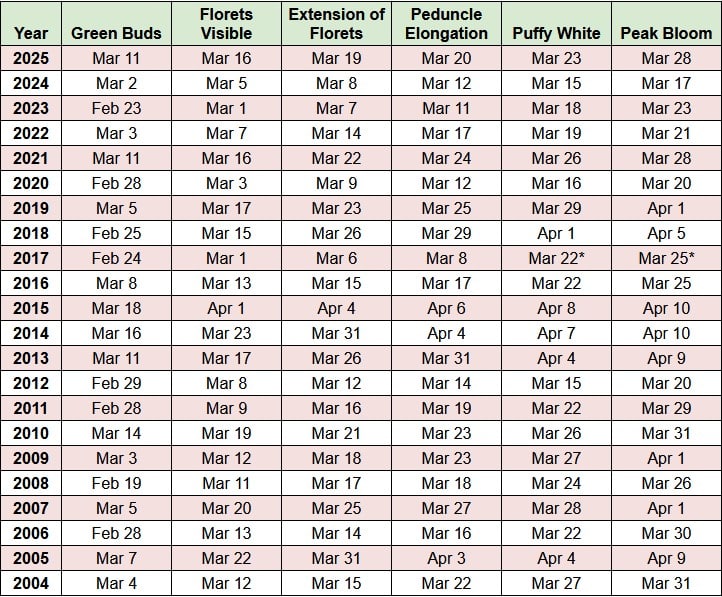
The National Park Service states that it’s almost impossible to predict peak bloom more than 10 days in advance, though. And sometimes late weather can affect the flowers even after they blossom: in 2017 we had a late frost that caused the loss of half the blooms. Another year we had strong winds that meant our cherry blossoms didn’t hang around long!
When Should You Visit to See Cherry Blossoms?
Every year, it’s difficult to predict when to plan a visit. Those of us that live in the area are lucky.
However, it’s worth noting that there are many locations other than the Tidal Basin to see spring blooms in Washington, D.C. And because of the different bloom cycles and area topography, those flowers often bloom before or after the cherry blossoms!
The Washington Post meteorologists known as the Capital Weather Gang issue their initial prediction in early March.
The National Park Service and Cherry Blossom Watch also post their own predictions which they update regularly.
These are the best local resources for predicting when the DC cherry blossoms will bloom. I recommend keeping an eye on all three of those sites above and their Facebook pages below.
National Park Service | Cherry Blossom Watch | Capital Weather Gang
Weekday mornings will be less crowded. After work and on weekends, locals mix in with the visitor traffic and it gets extremely busy.
DC Insider’s Tip on When To Visit:
If you plan to be in DC around the typical start of peak bloom, you have a good chance to see cherry blossoms in other parts of the city too. Plus you could see magnolias, flowering plums, forsythia and other gardens in bloom. If the Yoshino cherries bloom early, I’ve got tips on where to see later-blooming Kwanzan cherries and tulips!

Washington DC Cherry Blossom History
People lucky enough to have visited DC during spring usually know that Washington, D.C.’s first cherry blossoms were a gift of friendship to the city from Tokyo. But few know that it was a lifelong mission of a local resident, writer Eliza Ruhamah Scidmore, to see Potomac Park planted with cherry trees.
Having visited her brother in Tokyo, where he worked for the U.S. Consulate, Eliza returned to the U.S. in 1885 wanting to share her appreciation for Japanese people and culture, and most of all their cherry trees. Over the next 24 years she presented her idea to many people until eventually she wrote to to First Lady Helen Taft. The First Lady agreed, and when it became known that the First Lady wanted to order trees for the Tidal Basin, a gift of 2,000 cherry trees was sent from Tokyo in 1910.
Unfortunately, the original 2,000 trees were diseased and had to be destroyed, but another shipment of 3020 trees was graciously sent. In a ceremony on March 27, 1912, First Lady Helen Taft and Viscountess Chinda, wife of the Japanese ambassador, planted the first two of these trees on the north bank of the Tidal Basin. These two trees still stand, marked by a plaque near the Japanese lantern which is lighted each year during the festival.

National Cherry Blossom Festival
The National Cherry Blossom Festival is an annual spring event in Washington, D.C. Its dates are set ahead of time and are not dependent on peak bloom, although the two often overlap. The 2026 festival runs from March 20 to April 12, 2026, and this year it coincides with America’s 250th anniversary celebrations, making it a particularly memorable season.
Family-friendly activities, events and fundraisers occur throughout the festival. The major events include:
- Pink Tie Party: March 13, 2026 The stylish gala that kicks off the blossom season. This year’s theme is “Art of Fashion.” Tickets required.
- Opening Ceremony: March 21, 2026 | 5:00–6:30 PM Held for the first time at DAR Constitution Hall in Northwest DC, the Opening Ceremony is a cross-cultural celebration of the 1912 gift of trees from Japan. Expect traditional and contemporary performers from both countries, including the Futago Onikenbai sword dance. Free with a $5 ticketing fee — advance ticket acquisition required.
- Blossom Kite Festival: March 28, 2026 | 10:00 AM–4:00 PM | Washington Monument Grounds This is one of the best free events of the festival! This year’s kite competition has a patriotic “Red, White and Bloom” theme in honor of America’s 250th birthday. Open kite flying on the public field — bring your own kite or kids can make one at the activity station. Free.
- Petalpalooza: April 4, 2026 | 1:00 PM–9:00 PM | Capitol Riverfront at the Yards, 1300 First St SE A day-long, all-ages street party in the Capitol Riverfront neighborhood with live music, art installations, food, and the festival’s signature fireworks display at 8:30 PM. New this year: the “Cherry Blast” component. Near Navy Yard Metro. Free.
- National Cherry Blossom Festival Parade: April 11, 2026 | 10:00 AM–12:00 PM | Constitution Avenue NW One of DC’s biggest annual parades, running 10 blocks along Constitution Avenue from 7th to 17th Street NW. Floats, balloons, marching bands, and performers. Free to watch along the route — arrive early for a good spot. This year’s performers include David Archuleta and Gabby Samone.
- Cherry Blossom 10-Mile Run & 5K: April 11–12, 2026 The Credit Union Cherry Blossom 5K Run-Walk is on April 11 and the 10-Mile Run is on April 12. A beloved DC spring tradition that passes through prime blossom territory.
How to Get to Washington DC’s Cherry Blossoms
Taking Public Transportation
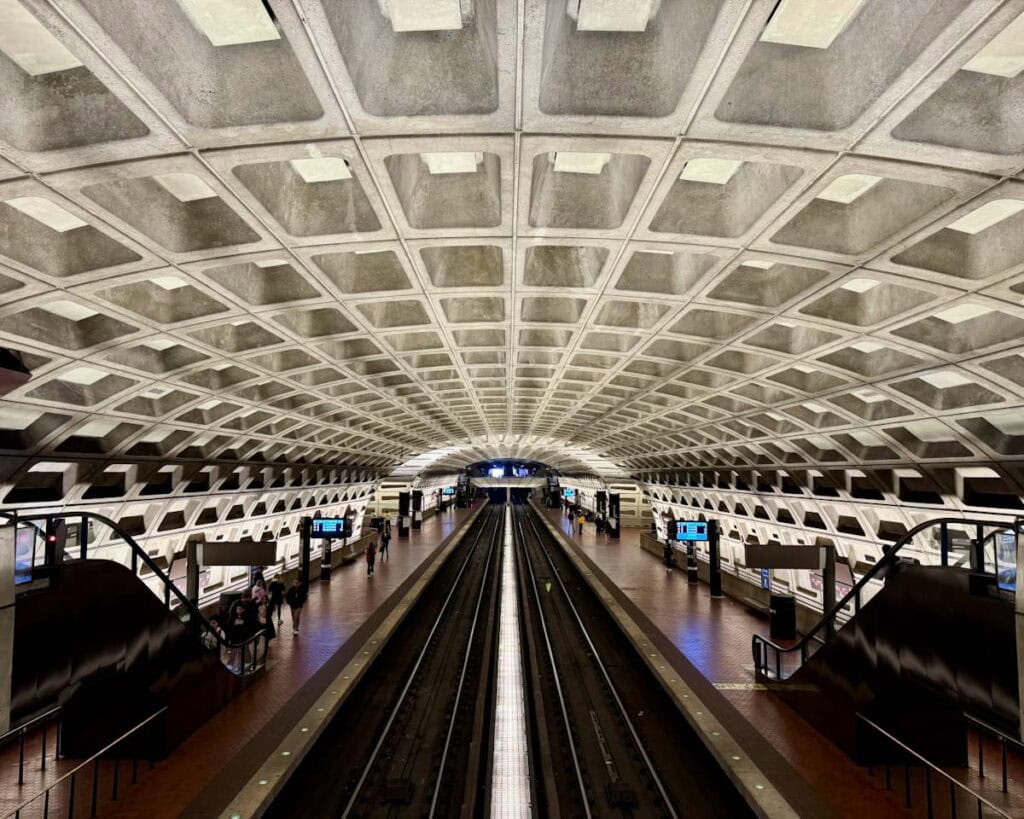
To see DC’s cherry blossoms at the Tidal Basin, I recommend taking the Metro (subway/rail) and then a local Metro bus.
The best Metro stop for cherry blossoms is the Smithsonian Station. By Metro, use the Blue, Orange or Silver lines and exit at the Smithsonian stop. From there, it’s a 10-15 minute walk to the Tidal Basin Welcome Center at 1501 Maine Avenue SW. The Archives station is also nearby (Green, Yellow Lines).
The best way to plan your routes using public transportation is to use Google Maps, which gives real-time updates on buses and trains. Get more tips on must-have apps for visiting Washington DC here.
Driving and Parking: Not Recommended, But Here Are Some Tips
Driving to see DC’s cherry blossoms is never ideal, and in 2026 it’s especially complicated. The seawall construction project has changed road access and parking conditions along Ohio Drive and the southern edge of the Tidal Basin; some areas that were accessible in previous years are now altered or closed. If you do drive, here’s what to know.
Reserve parking in advance with SpotHero. The National Cherry Blossom Festival’s official parking partner is SpotHero, which lets you book a guaranteed spot ahead of time at rates often significantly lower than drive-up pricing. During peak bloom weekends, parking fills fast — booking ahead is strongly recommended if driving is your only option.
The Tidal Basin lot by the paddle boat landing is closed during the festival, as it is every year. Do not plan to park here.
Ohio Drive SW still has pay lots south of the Jefferson Memorial that are typically open during cherry blossom season when not restricted due to crowd conditions:
- Parking Lot A: 971 Ohio Dr SW, Washington, DC 20024
- Parking Lot B: 1070 Ohio Dr SW, Washington, DC 20024
Note that Ohio Drive access and traffic flow in this area may differ from prior years due to ongoing construction work. Check for current restrictions when you arrive, and download the ParkMobile app to pay for street parking by phone and get alerts when your time is running out.
Underground parking is available at the Reagan Building at the corner of Constitution and 14th Street (info here). This is a good option if you also plan to explore other National Mall sights. A security inspection of your car is required before entry.
DC Insider’s Tip: Download the Parkmobile app to pay for parking using your phone and get alerts to remind you when your time expires. Parkmobile can be used in many locations throughout the DMV (what locals call the DC metro area that includes the District, Maryland, and Virginia).
Other than sunrise photos, I do not recommend driving to see cherry blossoms. Driving in Washington, D.C. can be very confusing and traffic gets especially busy in the early afternoon.

Bikeshare and Scooters
Other transportation options include Capital Bikeshare and dockless scooters. Capital Bikeshare has many stations around the Tidal Basin and National Mall area.
Uber and Lyft
Of course, Uber and Lyft are also great options to help you get around town. Keep in mind, though, that traffic can get really bad in the afternoons, and it could be difficult for a driver to reach you through the traffic. If you need a dropoff point for arriving at the Tidal Basin, there’s a bus loading zone at the Jefferson Memorial that could be a good quick spot to hop out without holding up traffic.


I came across this adorable “wedding photo shoot” at the Tidal Basin one year!
Tidal Basin and Cherry Blossom Tours
This 4-hour guided tour is one of the top picks for DC spring tours with online bookings – and it has a TripAdvisor badge of excellence.
DC’s Big Bus Tours, a hop-on hop-off bus, is a way to get around while adding in other area sights. Or there’s even a Cherry Blossom Segway Tour!
More Cherry Blossom Festival Planning & Logistics
Strollers
On peak bloom weekends, the Tidal Basin paths get very congested. Wide jogging strollers can be genuinely difficult to navigate when the loop is shoulder-to-shoulder. If you’re visiting with a stroller or wagon on a busy day, consider: arriving before 7:30 AM when it’s quiet, or heading to East Potomac Park instead: the paths there are wider, far less crowded, and also lined with cherry trees.
Kid carrier backpacks make it easier to navigate the crowds.
Tidal Basin Paddle Boats
One of the best ways to experience the cherry blossoms is from the water. Pedal boat rentals reopen for the 2026 season on March 14 and are walk-up only from March 14 through April 12 during the Cherry Blossom Festival.
The dock is on the eastern side of the Tidal Basin near the Welcome Center, and boats open at 10 AM daily. Rates are $38/hour on weekdays and $40 on weekends and holidays, for up to four passengers. Arriving right at 10 AM on a weekday is your best bet to avoid a line. Outside of cherry blossom season, reservations are available online at boatingindc.com.
DC Insider’s Tip: Budget 90 minutes total — an hour on the water plus check-in time. The view of the Jefferson Memorial framed by cherry trees from the middle of the basin is completely different from anything you see on shore. Worth every penny.
Restrooms Nearby
Check the map for restroom locations and note that they are usually found at each of the memorials. During cherry blossom season, portable restrooms are also set up near the paddle boat dock area.
Click here to jump back up to the map earlier in this guide.
Food near the Tidal Basin: what to actually expect
Honest answer: food options immediately at the Tidal Basin are limited and expensive. Here’s how to navigate it without overpaying or going hungry.
NPS Food Kiosks (best on-site option)
The National Park Service operates food kiosks throughout the Mall, and the most useful for cherry blossom visitors are the Jefferson Memorial Food Kiosk and the Tidal Basin Food Kiosk near the paddle boats, both open daily from approximately 9:30 AM–6:00 PM during the season. Other kiosks are scattered near the Lincoln Memorial (two locations — one serving specialty burgers, one with cheese and protein platters) and at several Smithsonian museums along the Mall. The food is straightforward (burgers, sandwiches, BBQ, pizza) but it’s legitimately run, consistently priced, and far better than what you’ll pay at the food trucks. Check letseatonthenationalmall.com for the current kiosk map and menus.
Food trucks
You’ll see food trucks parked along 14th Street and 7th Street during peak bloom, and they’re hard to miss when you’re hungry. Prices can be significantly marked up during festival weekends, and $15–20 for a basic meal is not unusual. They’re fine in a pinch, but they’re not a bargain. If cost matters, eat before you arrive or use one of the other options listed here.
Sit-down spots within walking distance
- The US Holocaust Memorial Museum Café is open to the public without needing a museum ticket, and is one of the closest real sit-down options to the Tidal Basin. Check their website for current hours.
- The Sweet Home Café at the National Museum of African American History and Culture is one of the best meals you can get near the Mall, serving up scratch-made regional American dishes far above typical museum fare. You don’t need a full museum timed-entry pass; the museum offers a separate Dine and Shop Pass (released seven days in advance on a rolling basis) for café and gift shop access between 11 AM–2:30 PM. Book it ahead of time — it fills up, especially during cherry blossom season.
- The USDA Cafeteria on Independence Avenue is open to the public and is an underrated budget-friendly option very close to the Tidal Basin. Confirm hours before visiting.
- The Reagan Building Food Court at 1300 Pennsylvania Ave NW, about a 10-minute walk from the Tidal Basin. With 17 eateries and seating for nearly 1,000 people, it covers everything from sushi and stir-fry to gyros and BBQ. It’s open Monday–Friday 7 AM–7 PM and Saturday 11 AM–5 PM. Note that it’s a federal building, so you’ll pass through a quick security screening on entry. Closed Sundays.
Indoor Picnics for Rainy/Cold Days
The Kogod Courtyard (8th & G St NW, open daily 11:30 AM) is the unambiguous winner here. Outside food and beverages are welcome in designated spaces in the Kogod Courtyard Smithsonian American Art Museum — so bring lunch or grab it somewhere nearby, duck inside this stunning glass-canopied atrium, and eat in peace while everyone else is fighting for a bench at the Tidal Basin. It’s a 15-minute Metro ride away, but on a cold or wet day it’s absolutely worth it.
DC Insider’s Tip: Pack snacks and a refillable water bottle. Water fountains near the Tidal Basin are limited — the FDR Memorial has one (as do most memorials), and there’s a snack kiosk near the paddle boats, but bottled water sells for a premium anywhere in the area during peak bloom. Coming prepared saves both money and a long walk when you’re tired.
Outdoor picnicking
The grounds around the Washington Monument are genuinely one of the best-kept picnic secrets during blossom season. The Monument area offers more open space, cherry trees nearby, and far fewer people per square foot. Spread a blanket on the grass and you’ll have one of the great DC views to yourself (relatively speaking).
Hains Point at the southern tip of East Potomac Park has picnic tables, playgrounds, and restrooms, plus cherry trees and water views on three sides. It’s less crowded than the Tidal Basin and a legitimately lovely spot for a longer, leisurely lunch.
Note: alcohol is not permitted on NPS grounds, and rangers are out in force during peak blossom weeks — so leave any grown-up beverages at the hotel.
Click here to jump back up to the map earlier in this guide.
Tips for Photographing DC’s Cherry Blossoms
This is the case where the early bird gets the worm! I prefer to wake up early and get sunrise shots of DC cherry blossoms with fewer people around. For photographers, the best times for taking photos of cherry blossoms are in the “golden hours”: the first hour after sunrise and the last hour before sunset. The “blue hour” 20-30 minutes just before sunrise and after sunset can also yield stunning shots.
2026 Photography Notes
If you’ve photographed the cherry blossoms before, expect some changes this year. The stretch along the south side of the Tidal Basin — between the Jefferson Memorial and the Inlet Bridge — looks different. The old cherry trees in that area have been removed as part of the seawall construction, and the grassy bank is fenced off. Clean shots from that particular angle will be difficult.
The great news: the Jefferson Memorial itself is finally free of scaffolding for the first time in several years, making for cleaner monument shots than we’ve had recently.
Best alternatives for photographers in 2026:
- The Tidal Basin paddleboat area near the Welcome Center still provides the classic Jefferson-framed-by-blossoms angle from the northern bank.
- The western bank between the FDR and MLK Memorials remains fully open and is still the best sunrise spot for Jefferson Memorial shots across the water.
- East Potomac Park is an underrated gem for photography any year, but especially in 2026. Wide tree-lined paths, no fencing, and far fewer crowds. Head there after your Tidal Basin sunrise for longer rows of blossoms and more room to shoot.
Basic Photo Tips for Cherry Blossoms:
- Clean your camera lens of dust and fingerprints, especially if you’re using a camera phone.
- Cherry blossoms look striking framing the monuments. Try shots with the blossoms in focus, monument in focus, and vice versa.
- Does your camera have a “portrait” setting? This will blur the background of your photo, which works great for close-ups of blooms.
- Take shots from different heights and angles, not just shots from chest level. If you’re photographing kids or pets, always kneel or take shots at their eye level.
- Use reflective surfaces like puddles to your advantage. If it’s a still morning, the water of the tidal basin is gorgeous reflecting the blooms in the morning light!
- From a distance, people in your shots can give interesting perspective.
- Editing your photos just a little bit makes a big difference. Even using the auto feature on your iPhone will punch up a photo to make it look better for Instagram.
- The best shots of the Jefferson Memorial at sunrise are from West Potomac Park from the FDR Memorial to the MLK Memorial. Get shots of the Washington Monument framed by blossoms here too.
- After sunrise, you can get a pretty shot of the Jefferson Memorial framed by cherry blossoms from near the tidal basin paddle boats.
- There are some DC photography groups that meet up to take photos of the cherry blossoms each year. If you’ll be in town and want to shoot with fellow photographers, you can follow IGDC on Facebook for event updates or Shutterbug Excursions on Meetup.

Other Blossom Spots in Washington, D.C. Great for Photos

These other spring bloom locations are great additions to your cherry blossom itinerary. At the end of this section, I’ve pinned them all to a map that includes the descriptions. Click on the links below to visit the garden’s website and for detailed directions.
MLK Memorial
The Martin Luther King Memorial has forsythia that bloom before the cherry blossoms.

Floral Library
This small garden blooms with a “library” of tulips in April. You can get a low-angle shot of the Washington Monument framed by tulips.

Rawlins Park
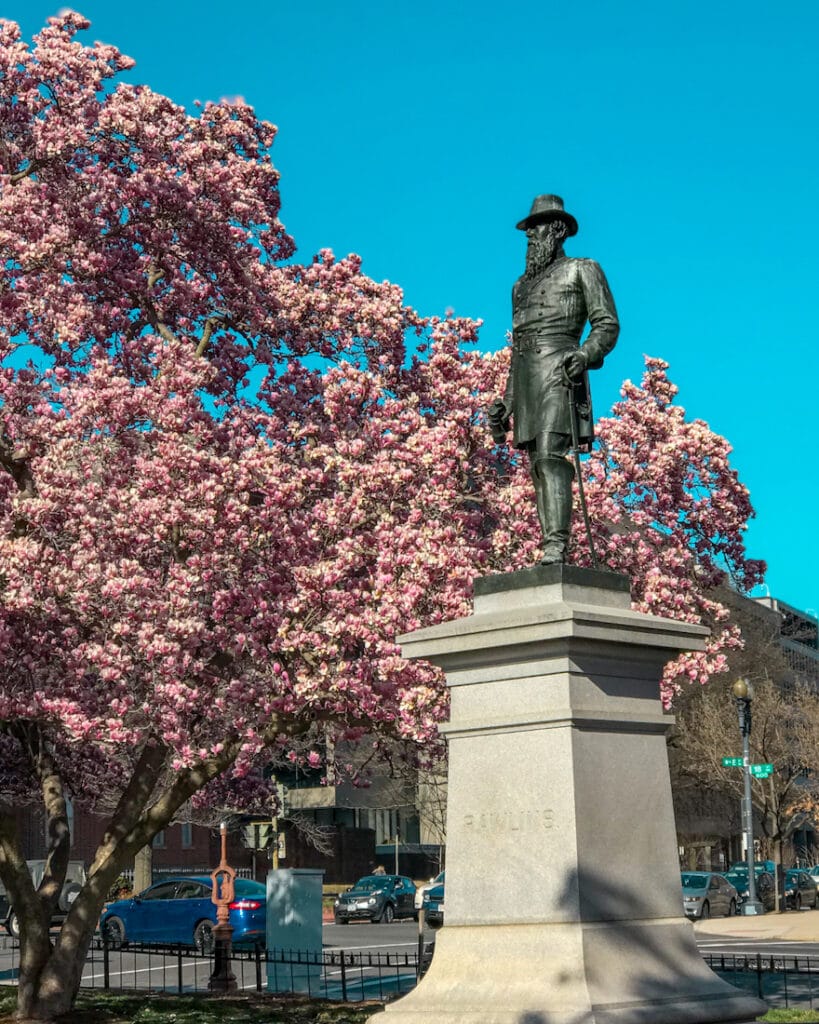
Rawlins Park is another early blooming spot in DC! It’s a small park located in the Foggy Bottom neighborhood, a few blocks from the National Mall. In mid-to-late March, the saucer magnolia trees that line the park bloom.
Note: this park is currently closed due to fountain construction with an estimated completion date of May 15, 2026.

Enid A. Haupt Garden at the Smithsonian Castle
The Enid Haupt Garden has blooms throughout the seasons, starting with magnolias in mid-to-late March. Then expect to see cherry blossoms, tulips and sweet-smelling hyacinth among many other flowers. Don’t miss the section called the Moon Gate Garden, for lovely reflections of the Smithsonian Castle and early-blooming paper bush that smells amazing! Located on the National Mall here.

Stanton Park
Stanton Park is a pretty location for magnolias in Capitol Hill, a few blocks from the Capitol Building.

Dumbarton Oaks
Dumbarton Oaks is one of my favorite places in the city! This former private home in Georgetown is now a museum and research facility. Its garden with gorgeous terraced areas and rambling park space is open each day from 2-5pm. Dumbarton blooms throughout the seasons, but in spring (mid to late March) you’ll see forsythia, plum, magnolia and cherry blossoms among many others. Find prices and bloom info here and a map here. Be aware that Dumbarton can get very busy with locals trying to avoid other touristy parts of the city, and only street parking is available.

National Arboretum
The National Arboretum is a joy to visit any time of year, and has cherry blossoms, azaleas, and many other blooms spring through fall. Don’t miss the bonsai museum and National Capitol Columns! It’s located here and is accessible by bus or car (parking is available).

Washington National Cathedral’s Bishop’s Garden
The National Cathedral’s Bishop’s Garden is another favorite DC spot. To the right of the Washington National Cathedral is a small gate to the Bishop’s Garden. This garden has star magnolias and weeping cherries that bloom in mid-to-late March, and you can get an amazing shot of the Cathedral framed by blossoms from the bottom of the garden. Tulips, iris and other flowers bloom from spring through summer here. Pay to park in the Cathedral lot or find a spot in the neighborhood sidestreets.


Arlington National Cemetery
Arlington Cemetery is located just across Memorial Bridge from DC, so I’m including it as a DC cherry blossom spot as well. This is a moving place to visit, and beautiful in all seasons. The cemetery is large and has about 400 cherry trees throughout its 624 acres. Some of them bloom later into May as well.

Map of Other Places to See Cherry Blossoms
Looking for more Washington DC blooms?
Check out my guide to the best Washington DC gardens, with details on where to see blooms in every season and tons more “insider” DC tips!
Planning Your Trip to Washington DC
Cherry Blossom Season Weather
Wear layers and be prepared for anything: early spring in DC can be cold, windy, rainy, and warm all in the same day.
The good news: the years of chronic flooding and muddy paths along the Tidal Basin are finally over thanks to the recently completed seawall reconstruction. However, note that the southern section of the Tidal Basin path is fenced off for 2026 (see the construction section above), so plan your walking route accordingly and wear comfortable shoes for the sections that are open.

Cherry Blossom-Themed Foods
Some DC restaurants get in on the blossom frenzy and add themed items to their menu! I will post links as I see local news. There’s sometimes a blossom-themed pop up bar too!
Georgetown Cupcake (of “DC Cupcakes” fame) usually has cherry blossom-themed cupcakes each year. Old Town Dolci in Old Town Alexandria, Virginia and Ice Cream Jubilee often have seasonal flavors as well.
DC Insider’s Tip:
Order Georgetown Cupcakes online by 5PM and select a time to pick them up the next morning. You can skip the line and go right to the front counter to pickup assistance from staff. Then wander down to the Georgetown Waterfront to devour them with a view!
Where to Stay to Visit for Washington DC Cherry Blossoms
Washington DC has a ton of great neighborhoods to explore. For a visit to see cherry blossoms, I’d recommend that you stay at a hotel within relatively easy access to the Tidal Basin. The best budget hotels will be close to a Metro station either in DC or Arlington, Virginia which is just across the Potomac River. I would recommend avoiding Georgetown and Adams Morgan, because those neighborhoods don’t have Metro stops.
Prices for hotels in DC can increase dramatically during the spring and summer tourism seasons. Hotels also book up early, so I’ve tried to give lots of options in different price ranges.
Keep in mind that parking at hotels in Washington DC can get pretty expensive — be sure to check this on each hotel listing if you will have a car.

Best Hotels for DC’s Cherry Blossom Season
These options put you closest to the Tidal Basin and the National Mall, with the easiest walking and transit access.
Holiday Inn Washington Capitol — National Mall (Budget): A reliable, no-frills option a few blocks from both the Smithsonian Metro stop. It’s one of the most affordable hotels in this immediate area, with on-site dining and plenty of room for families. Reviewers highlight the convenience of the location above all else.
citizenM Washington DC Capitol (Budget–Mid-Range): A stylish, compact microhotel just steps from L’Enfant Plaza Metro and about a 15-minute walk to the Tidal Basin. A strong choice for solo travelers or couples who want a central, well-designed space without paying full DC hotel rates. Reviewers consistently rave about the breakfast and the tech-forward rooms. Fair warning: the rooms are small, so it’s not ideal if you’re traveling with kids or lots of luggage.
Hyatt Place Washington DC/National Mall (Mid-Range): One of the best-located hotels for cherry blossom season, sitting just south of the National Mall between L’Enfant Plaza and Federal Center SW Metro stations — both within easy walking distance, and L’Enfant Plaza connects five Metro lines. Free breakfast buffet is included, which is a genuine money-saver in pricey DC. Rooms are spacious by DC standards, and the rooftop bar has great city views. Good pick for families.
Hyatt House Washington DC/The Wharf (Mid-Range): Located right on The Wharf waterfront, about a 15-minute walk to the Tidal Basin and close to L’Enfant Plaza Metro. The suite-style rooms make it one of the better options for families who need a little extra space. The location is a bonus beyond cherry blossoms — you’re steps from some of DC’s best waterfront dining, and Petalpalooza (April 4) happens practically outside your door. Highly rated by recent guests.
Salamander Washington DC (Splurge): The closest true luxury hotel to the Tidal Basin, located about a 10-minute walk away on Maryland Avenue SW. The property was recently reimagined with a new lobby, lounge, and terrace, and the on-site restaurant Dōgon by Chef Kwame Onwuachi is destination-worthy on its own. If you want to wake up, walk to the cherry blossoms at sunrise, and come back to a spa and rooftop views of the Potomac, this is your pick.
More Downtown DC Hotels
A little farther from the Tidal Basin but well-connected by Metro and buses, with more dining and nightlife options nearby.
Motto by Hilton Washington DC City Center (Budget–Mid-Range): A compact, well-designed hotel near Gallery Place/Chinatown Metro (Red/Green/Yellow lines) and within walking distance of Union Station, where you can take the Metro or catch a bus to the Washington Monument/National Mall. Rooms are on the small side — this is very much a “location and style over space” hotel — but at DC prices, the value is hard to beat. Reviewers frequently mention the great bar and the genuinely helpful staff.
Kimpton George Hotel by IHG (Mid-Range–Splurge): A stylish boutique hotel steps from Union Station Metro (Red Line), which puts you about 20 minutes from the Smithsonian stop with one transfer. The Capitol Hill location is great for exploring beyond just the Mall, and Kimpton perks like the complimentary evening wine reception and free bike rentals add genuine value. On-site restaurant Bistro Bis is a DC institution. Note that valet parking runs $60/night, so factor that in if you’re driving.

Arlington and Alexandria, VA Hotels
Staying on the Virginia side of the Potomac is a great strategy for cherry blossom season — hotels tend to be less expensive than central DC, parking is more manageable, and you can be on the Blue Line and at the Smithsonian Metro stop in under 20 minutes.
Important reminder: Take the Blue Line (not the Yellow Line) from Virginia stations. The Blue Line goes directly to the Smithsonian stop with no transfer required.
Hampton Inn Alexandria Old Town / King Street Metro (Budget–Mid-Range): One of the best-value options on the Virginia side. It’s one block from King Street Metro (Blue/Yellow lines), which gets you to the Smithsonian stop in about 20 minutes with no transfer on the Blue Line. On-site parking garage is a rare and welcome perk at just $20/night. Old Town Alexandria is a lovely neighborhood with great walkable restaurants and shops — a nice bonus on top of an already practical location. Consistently well-reviewed.
Hilton Alexandria Old Town (Mid-Range): Also near King Street Metro, this is the slightly more spacious and upscale option in the same Old Town corridor. A good pick for travelers who want the Old Town neighborhood vibe with a bit more room. Some reviews note the property could use a refresh — worth reading recent reviews before booking.
The Ritz-Carlton Pentagon City (Splurge): The Virginia-side splurge option. Connected via sky bridge directly to Pentagon City Metro (Blue/Yellow lines) and Pentagon City Mall, which is handy if DC spring weather turns on you. A well-recognized luxury property, although some reviewers note it doesn’t quite deliver the full Ritz-Carlton experience compared to newer properties in the brand. That said, the transit access is genuinely excellent and the location is easy for arrivals into Reagan National Airport.
Check more hotel rates: Expedia DC Hotels | Expedia Arlington Hotels | Expedia Alexandria Hotels
Prices increase significantly during peak bloom weekends. If your travel dates are flexible, arriving mid-week during the festival (rather than the weekend of predicted peak bloom) can save you considerably on hotel rates — and weekday mornings at the Tidal Basin are far less crowded to boot.


Cherry Blossoms Frequently Asked Questions (FAQ)
No official prediction is issued until about 10 days before bloom. After DC’s record-cold winter, the National Park Service expects bloom to arrive later than recent years — the most likely window is late March through early April. Check the NPS Bloom Watch and Cherry Blossom Watch as your trip approaches. In 2025, peak bloom arrived March 28.
Peak bloom — when 70% of the Yoshino cherry trees are open — typically lasts 4–7 days in good conditions. Wind and rain can shorten that window significantly. The broader “still beautiful” window, including pre-peak and the days just after, is usually closer to two weeks. The full festival runs March 20 to April 12, so there’s flexibility even if you miss the exact peak.
Yes. The Tidal Basin, National Mall, and all the memorials are free to visit. The festival events like the Kite Festival and Petalpalooza are also free. You’ll only spend money on transportation, food, parking, and optional activities like paddle boats.
Early morning — ideally at or just before sunrise. The light is beautiful, crowds are minimal, and you can actually walk the paths at a comfortable pace. By 10 AM on peak bloom weekends it’s shoulder-to-shoulder. Weekday mornings are significantly calmer than weekends at any time of day.
Very. The festival draws over 1.5 million visitors. Peak bloom weekends are the worst — expect slow-moving crowds on the Tidal Basin loop from mid-morning onward, long waits at food vendors, and full parking lots by 9 AM. Weekday visits, early mornings, and overcast days are all meaningfully less crowded.
Yes, dogs are welcome on leash throughout the Tidal Basin and National Mall grounds, which are NPS-managed public land. Just be aware that on peak bloom weekends the paths get extremely crowded, which can be stressful for dogs (and their owners). Early mornings and East Potomac Park are better bets if you’re bringing a pup.
Yes, picnicking on the National Mall and Tidal Basin grounds is allowed and encouraged. Note that alcohol is not permitted on NPS grounds, and rangers are out in force during the festival. For a more comfortable lunch spot out of the crowds, the Kogod Courtyard at the Smithsonian American Art Museum welcomes outside food in its designated seating areas.
Yes, see the paddle boat section above for 2026 hours and pricing. During the festival, rentals are walk-up only (no advance reservations). Arrive at 10 AM on a weekday for the shortest wait.
Ready to see some cherry blossoms?
I love living in Washington, D.C., and after more than 15 years here, I’m really excited to share my best tips for experiencing spring in our nation’s capital. If you see me at the Tidal Basin or other gardens, be sure to say hi!
Pin this guide for reference when planning your trip and for access to my map of cherry blossoms in DC when you get here!


The Haphazard Traveler is a participant in the Amazon Services LLC Associates Program, an affiliate advertising program designed to provide a means for sites to earn advertising fees by advertising and linking to Amazon.com. As an Amazon Associate I earn from qualifying purchases.
